Showing posts with label reviews. Show all posts

Saturday, August 10, 2013

In the Beginning was Information

In the Beginning was Information by Werner Gitt

Note: This review is a bit technical.  Sorry.

I was looking forward to this book for a couple of reasons.  First, the mysterious concept of "information" has been showing up in some of the physics books I've been reading.  For example, The Black Hole War was largely concerned with whether information is conserved when something falls into a black hole.  I got the feeling that "information" is some new, fundamental concept in the universe, right up there with matter or momentum.  Second, some of the more reasoned critiques of evolution question whether random selections and mutation can really generate "information" for more complex life.  That appears to be a profound claim, but I needed some background on information in order to evaluate it.  This particular book was recommended by Answers in Genesis, and I'd hoped that it would give some good background as to what this mysterious information concept circulating both physics and biology is, and then apply it to evolution.

I was sorely disappointed.

The book is written in an excessively methodical manner, where one statement after the next is written in almost an outline for a formal proof.  This is great if you're trying to make a formal proof, and perhaps Werner Gitt is, but it makes for terribly dry reading.  It also provides the appearance of correctness, as most of us are scared of this kind of writing.  Only really smart people do it, so he must be smart, right?

Gitt then wastes over thirty pages before getting to information.  There's some groundwork on physical laws, but really it's nothing useful unless you're new to science, in which case this is the wrong book for you!

The actual content begins in chapter three and continues in its propositional format.  It quickly becomes clear that Gitt views information as intricately tied to intelligence, not just a property of the matter involved, calling it a "mental quantity".  He may, at first, just mean that it's non-material, but by "Theorem 2" (see, it reminds you of a math class!) we're told that "Information only arises through an intentional, volitional act."  By the next chapter information requires a sender and a recipient and "every piece of information leads to a mental source, the mind of the sender."  We're also treated to a section on syntax and semantics of a code, and it felt eerily similar to the Theory of Computation course I took last year (and not at all pleasant considering my experience!).

At this point it became clear that whatever this book is talking about is not the same "information" as science, certainly the physics, is talking about.  (That might be something mentioned briefly called "Shannon's information", but I need to do more research still.)  Black holes couldn't care less whether the falling object has a code to it or not, and certainly no willful messages are being exchanged.  And yet the conservation of that information is critically important to physicists.  Clearly we're talking about two different things.

On the evolution front, this book is equally worthless.  The simplified argument I've heard is that genes have information content, random mutations won't form information, therefore evolution can't happen and you need a designer.  But Gitt's book kills evolution without a hearing by assuming the very thing he is trying to prove: that information requires a designer.  So of course evolution's absurd when you decree, as an unproven proposition, that all information requires a mind.  This is the "begging the question" fallacy, and committing it throws all credibility out the window.

I also note that a quick Google search (*after* reading the book, while writing this review) yields similar criticism on this and his other work:
Errors in Werner Gitt's work with Information Theory
Information Theory and Creationism: Werner Gitt
("If we use a semantic definition for information, we cannot assume that data found in nature is information. We cannot know a priori that it had an intelligent source. We cannot make the data have semantic meaning or intelligent purpose by simply defining it so.")

After a few pages of this, I gave up.  The argument is fundamentally flawed, and I'm not sure there's anything left to salvage from this book.  Future chapters were going to apply his knowledge against evolution (trivial given how he defined his terms) and show that there is information being sent from God to man in the Bible, which is also trivial considering, at the very least, there were human minds involved in writing it...

And being so incredibly boring and reminiscent of the more frustrating parts of math/computer science courses... I can find something way better to read.  (I'm getting hints from other books that God's Undertaker, by John Lennox, might in part discuss information.  Added to my pile.  And I'll probably add a secular, physics-y book on the topic too.)  So after about seventy pages, I put this one down.

It appears the entire book is readable online over here on Answers in Genesis's site.

1/5 stars, for masquerading as technical and damning when it's really just a fallacy
Review also posted to LibraryThing

Monday, September 24, 2012

The Checklist Manifesto

The Checklist Manifesto

I checked out The Checklist Manifesto, by Atul Gawande, as part of an attempt to get my life more organized and better prioritized.  (Let's just say I overcommitted a bit last spring.)  I also have a tendency to write down too many items on my todo lists, and they can lose their usefulness quickly.  I was hoping this would help me to use checklists more effectively.

I was wrong.  Well, mostly.  It turned out to be an argument for *doctors* to use checklists much more regularly in their operations, largely surgeries, in order to avoid forgetting to do obvious things.  As it turns out, there is a need:
"In 2001, [a previous checklist study was performed].  Doctors are supposed to (1) wash their hands with soap, (2) clean the patient's skin with chlorhexidine antiseptic, (3) put sterile drapes over the entire patient, (4) wear a mask, hat, sterile gown, and gloves, and (5) put a sterile dressing over the insertion site once the line is in.  Check, check, check, check, check.  These steps are no-brainers; they have been known and taught for years.  So it seemed silly to make a checklist for something so obvious.  Still, Pronovost asked the nurses in his ICU to observe the doctors for a month as they put lines into patients and record how often they carried out each step.  In more than a third of patients, they skipped at least one."
(pages 37-38, emphasis mine)

Yikes.

All very basic stuff huh?  As a patient, I just kind of assume that these things are happening behind the scenes and that they'd never make a mistake as simple as forgetting to wash their hands.  Evidently not.

In the next year the nurses were encouraged to correct the doctors when they witnessed steps being skipped.  "The results were so dramatic that they weren't sure whether to believe them: the ten-day line-infection rate went from 11 percent to zero." (page 38)  An estimated eight lives saved in one hospital, from making sure medical professionals remembered to sterilize everything!

Gawande then goes on to describe how checklists are used successfully in other fields, and this was surprisingly interesting as well.  For example, construction of large buildings/skyscrapers is evidently done by breaking the design into multiple subsystems, and each team effectively has a giant checklist they're working through.  And to make sure the different teams work nicely with each other, some of the tasks are communication-oriented, e.g. have a cross-team meeting to discuss potential issues after the water lines are put in.  Gawande is advocating a similar approach in medicine; instead of having one exalted physician or surgeon, maybe we should entrust our health to multiple experts and attempt to do a better job communicating amongst themselves.

Aviation was presented as the gold standard in checklists.  Evidently pilots have manuals which consist of hundreds of checklists on the plane every time they fly.  Most are never used, but they'll describe every possible disaster scenario and the really obvious first steps that must be performed.  One objection readers may have here and elsewhere is that in a crisis scenario the expert should be free to perform by intuition and not be restricted by red tape.  Gawande would disagree, to a point.  "The [airline] checklists have proved their worth--they work.  However much pilots are taught to trust their procedures more than their instincts, that doesn't mean they will do so blindly.  Aviation checklists are by no means perfect ... You want to keep the list short by focusing on what he called 'the killer items'--the steps that are most dangerous to skip and sometimes overlooked nonetheless." (pages 121, 123)  And they must be short, in the 5-10 item, ~30 second range.  At this point, the argument goes, you've removed the costliest, most frequent mistakes and it's time to let the experts act on their own and amaze us.

Gawande also believes that this line of reasoning could be extended to just about anything.  Like investing - did you actually read Company X's cashflow statement before buying its stock?  But I was a bit disappointed it wasn't more practical on a personal level.  There are things that fit into this approach, like remembering to pay the credit card bill, but my life is less ... procedural ... than things in this book.

But it was still a fascinating book.  Sometimes I amaze myself at the variety of things I can make myself interested in.  To be fair, this wasn't the first medical book I've read and enjoyed, but it probably was the first analysis of construction that's been written interestingly enough to hold my attention!  And in case you were wondering, Gawande did ultimately come up with a three-part, nineteen item checklist for use in surgeries that has performed well in testing so far.  It's also been winning many converts from skeptical doctors who usually think a bit too highly of themselves and see it as a waste of time, until the checklist saves someone from a (literally) deadly mistake!  Here's a sample of the current checklist:
"Before anesthesia, there are seven checks.  The team members confirm that the patient (or the patient's proxy) has personally verified his or her identity and also given consent for the procedure.  They make sure that the surgical site is marked and that the pulse oximeter--which monitors oxygen levels--is on the patient and working.  They check the patient's medication allergies.  They review the risk of airway problems--the most dangerous aspect of general anesthesia--and that appropriate equipment and assistance for them are available.  And lastly, if there is a possibility of losing more than half a liter of blood (or the equivalent for a child), they verify that necessary intravenous lines, blood, and fluids are ready." (page 140)

Maybe our next visits will be just a little bit safer :)

4.5/5 - I might actually purchase this one someday
Review also posted to LibraryThing


Thursday, September 13, 2012

I Judge You When You Use Poor Grammar

I Judge You When You Use Poor Grammar

This looked at first glance to be amusing, and I "read" through it (i.e. looked at pictures to find the mistake and read the author's sentence complaint) in about 30 minutes.  But in reality it was rather boring.  It felt like every picture the author was complaining about a misplaced or absent apostrophe.  Granted, it's not *that* hard to get apostrophes right, but it's a somewhat standard error, and there's only so many times you can see another sign that mistakes 'its' for 'it's' before it loses its hilarity.

There were some amusing bloopers - such as 'YEILD' written in official large lettering on a road, a 'DONT'T DRINK AND DRIVE' road sign, or a typo on an immigration form, but overall it just wasn't as exciting as it could've been with some more variety.

2.5/5 stars
Review also posted on LibraryThing

Friday, September 7, 2012

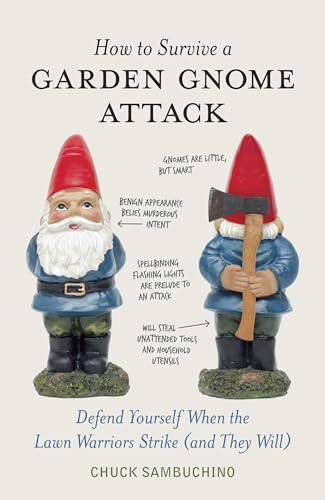
How To Survive A Garden Gnome Attack

This was a nice quick read a couple weeks ago.  It only took me two days, start to finish, which, the way I read and rotate through books, is amazingly fast.  In part it was because it was short, only about 100 pages, and many of them had large pictures.  More importantly, it was just too amusing to put down.  The premise is that gnome attacks are a widespread, undiscussed problem, and this is the definitive survival manual.  The author advocates, among other things, digging moats and placing quicksand (recipe provided - it needs maple syrup!) around your house to trap any approaching gnomes.  Once captured, the best way to "dispose" of them is to encase them in concrete...

I'm sure there are very similar books out there for zombie attacks, but this was the first I had heard dealing with gnomes. I wonder if there's a gnome subculture out there as there is for zombies, but I suspect not.  The author has evidently been asked many times where he got the idea (hey, that's exactly what my dad was asking as I read it!), and he answers that it was a snapshot of a movie that creeped him out.  So I suspect he made it up.  He also has an amusing blog on the subject over here.

I kinda want to buy a garden gnome now.  Since my sister also read this, it could "appear" in various places to scare her!

4/5 stars for pure creativity; probably won't buy it, but it was worth a read

Saturday, August 18, 2012

Doctor Who: Autonomy

Yes, I know my blog died.  All 0 of my readers were very upset!  I'm hoping to start posting book reviews, also posted to my LibraryThing profile as I finish them.  Anyone who knows me very well is probably asking if I ever actually finish a book.  Given how many I have in progress at a given time (my current spreadsheet has 200), it's a valid question.  But yes, I'm actually making some progress at the moment and have at least two that can be reviewed right now.  Now school is starting up again on Tuesday so I may not continue to have much success in reading regularly, but we'll see how long I can last.  So without further ado, one I finished about a month ago:


I've started reading the Doctor Who series recently since we love the TV show so much, and I continue to enjoy each book. This was probably my fourth. Compared to a lot of the other, non-Doctor Who books I read, the reading level is easy and it's good for nights when I just don't have a lot of concentration left over before falling asleep mid-page.

As far as the book goes, I didn't find the plot particularly unique for Doctor Who. There were a few more deaths than usual, and the amusement park setting was kind of fun. I do wish he'd have a companion, but there are definitely other books in the series which do.

4/5 star
LibraryThing Review

Monday, June 1, 2009

Review: Night at the Museum: Battle of the Smithsonian

So my family went to see Night at the Museum: Battle of the Smithsonian on Sunday, which is made more amazing by the fact that we don't go to many movies these days. Cheaper to rent and/or buy them later on. This one, however, was worth paying more to see in the theater - I enjoyed it a lot! Here's some a more detailed review:


Although I really liked Night at the Museum 2, it had a totally different appeal to me than the first movie did. The first was more or less realistic; if you can get past the premise of the exhibits coming to life at night, it was pretty believable. When the characters made a mess, our hero the night guard was in trouble the next day. This movie, however, completely broke with any sort of logical realism this time around. Here's some examples:
  • The range of the tablet's influence seems to be variable. Presumably, it should affect an area about the size of the museum in New York, or the next door homes would also have things coming to life. But it's range seems to be much greater at the Smithsonian, which the movie points out is multiple separate museums. My sister pointed out that the items "woke up" when the characters entered the building with the tablet, and hadn't beforehand, but there's still a problem: The bad pharaoh stayed alive even when the tablet left the building. Even worse, at the end of the movie it is acting both on the New York museum and the Smithsonian. Something doesn't add up.
  • There was no attempt at damage control. Multiple times significant messes were made and there was no attempt to hide them. It would be kind of obvious the next morning that something big happened if the Smithsonian visitors and staff came to entire windows being broken and substantial numbers of exhibits moved around as the bad guys' loot. Nobody makes any effort to clean up or set things right, which would lead to a major shock the next morning.
  • Speaking of which, where were all the people during the night? The characters were outside a few times and the area was deserted. Is the National Mall really completely deserted in the middle of the night? No cars? Surely there's more than one night guard on duty...Nobody at all?
  • I thought some of the characters were a little "out-of-character" and/or voice. Lincoln sounded nothing like what I would have expected, and he was portrayed to be far stupider than I believe he was as well. Other characters were equally bizarre, and I felt the whole thing was more of a comedy than a remotely-realistic analysis of what would happen if all these characters were together at the same time and place. Would we really be going on and on about Napoleon's height, as humorous as it may be?
  • In general, I just felt the movie was far less realistic than the first. The secret is out, and out in a big way. (And, to avoid a spoiler, this certainly applies to the ending, which was totally unrealistic, but amazing!)
But I did love the movie! I just loved it in a different way. The first one was intriguing; this was entertaining. There were lots of jokes to pick up and so many characters that everyone's bound to find a few they know. A little romance to keep my sister happy. But the realist in me needs to go away to fully appreciate the film for the comedy that it is.

One last complaint: The bobblehead Einsteins really should have made a crack about quantum gravity or string theory ;(